Residency Report No. 1
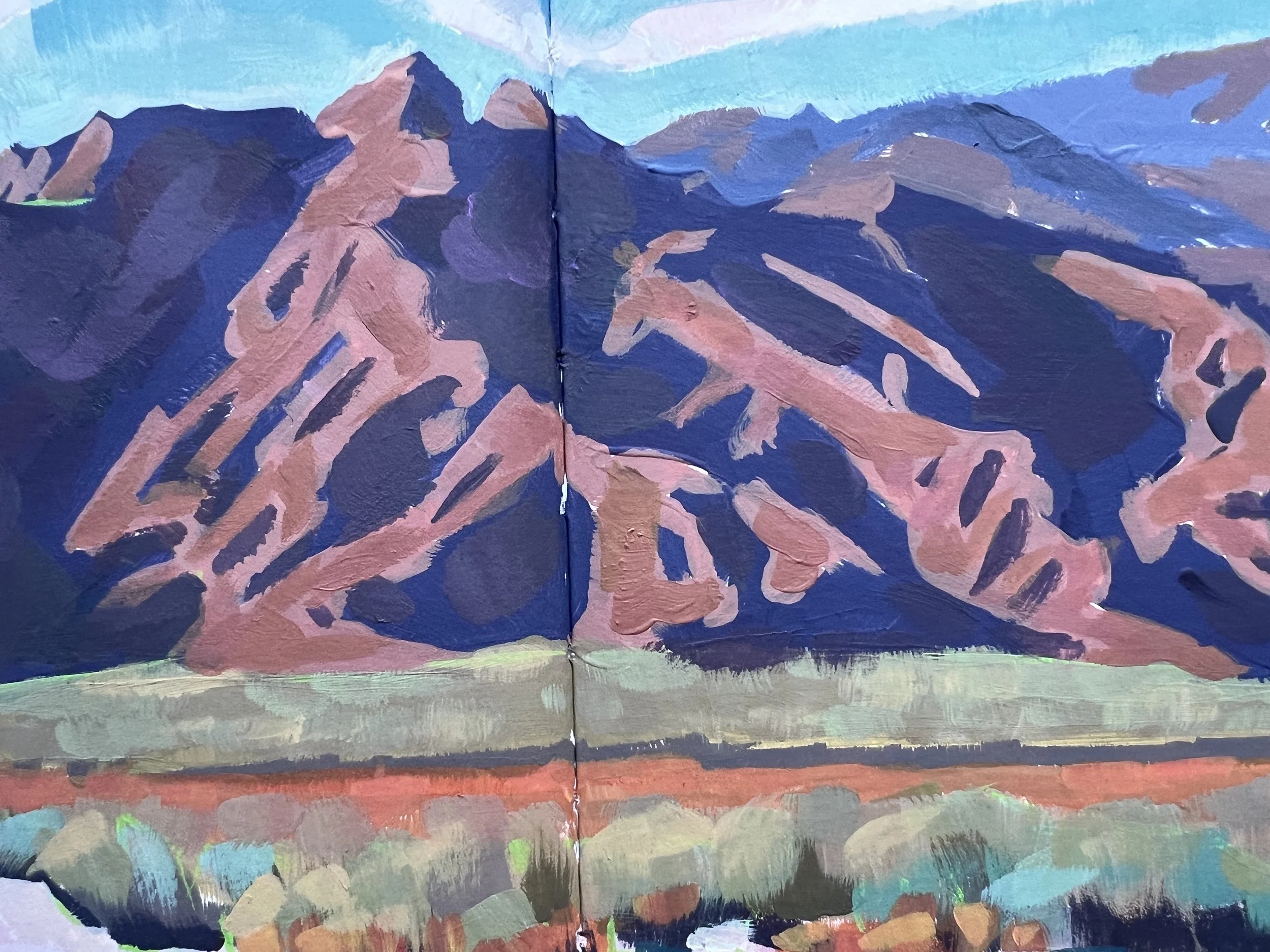
My master study of Maynard Dixon’s Desert Range (1940)
Amidst all the moving boxes, the chaos, and signing the children up for their new schools, I have plunged myself into art research and study. It feels good. It kind of feels like college, only now I’m older and wiser and can appreciate the luxury that is spending an entire day absorbing the history of an art movement, and assigning myself trips to museums so I can study works in person.
The goal at the end of 2025 was to begin laying the groundwork more formally for my love of genre painting specific to the West. Why? Well, as of January 1, 2026, I started a yearlong artist residency in Fort Worth, Texas: a mostly open-ended endeavor, as all things fine art tend to be, with a couple of minor stipulations by the organization sponsoring my residency, Sundance Square.
The first, of course, being the format: that at the end of the year, I will have a show. (By the way, you are all welcome 😊 If you’re reading this, I would love to have you at the show— more details to come 😉) The other residency stipulation is the inclusion in my work of the Fort Worth Stock Show & Rodeo, the longest consecutively running livestock show and rodeo in the world. I’ve been told by the locals that FWSSR is the heart of the city; people from all different walks of life and socioeconomic backgrounds participate in the show, whether it’s featuring accomplishments or showing animals that dedicated 4-H programs have spent time and energy on. This is something I’m familiar with as I grew up in the Missouri Ozarks, where 4-H was often the communal backbone of that part of the country as well.
After I had the conversation about my only two stipulations, I reached into my brain and mined everything I could about the rodeo, and specifically its relation to fine art. I know the rodeo on a vernacular level. At my high school, there was a clique of boys who proudly wore their belt buckles and bragged about how long they could stay on a bull. Country music and rodeo are threads that weave through my own childhood. I remember being a young kid, singing loudly along to the Tim McGraw lyric, “I spent 2.7 seconds on a bull named Fu Manchu.”
From my first obsession with the country bar scenes of Coyote Ugly, to many of my runs in high school and college cross-country being through pastures with horses grazing, I’ve been adjacent to this world, albeit not directly in it— I love a pair of cowgirl boots, but despite years of close proximity, I’m truly much closer to a city slicker to what my years in Missouri and Texas may have you believe. And yet, all the trappings of a love of rodeo and stock animals are there.
Ironically, the very first thing I thought of when I put my mind to the rodeo was its relationship to the art world. Given that I constantly have my artist hat on (and that this is an artist residency, after all) I suppose that makes sense. But my initial instinct to weave a fine art connection to the rodeo as a way to sew together these seemingly disparate worlds obscured in my mind, at first, how my own path has frequently brushed into the rodeo orbit. I may not know how to tie a lasso or ride a bull myself, but I’ve worked and gone to school with the people who do; I know their names and faces and how much pride they take in their world of animals and pageantry.
Something about totally missing my own personal relationship to this culture in favor of where rodeo sits on the modern art stage feels telling. It points to a disconnect I have, some days, with who I am in my career. I often use my art as a way to examine my own childhood, and this gap reminded me that I have a lot more work to do. I suppose that’s a good thing: as artists, we all can use the reminder not to get too bogged down by the constraints of the art world status quo from time to time.
That’s not to say that the West and its aesthetics are uncharted territory for painters. Far from it. I’m familiar with the genre work of Victor Higgins and Frederic Remington, and the horses of the so-called Wild West—the genre that often overlaps with rodeo and the aesthetics of Texas. I also think of the work of David Wojnarowicz, the painter who used the cowboy as a shorthand for masculinity and performative Americana as a way to process his own trauma during the AIDS crisis. He used the pageantry of the rodeo to examine how trauma around manhood and homosexuality played out culturally.
To perhaps put a cherry on top of all of this, as I give you my first residency temperature check—licking my thumb and sticking it to the wind, so to speak—I also have to say that one of my favorite songs of all time is Rhinestone Cowboy by Glen Campbell. Admittedly, what seems like a small, out-of-left-field thing to note, I think ties me even further to the ideas of pageantry, performance, and spectacle wrapped up in personal identity, and in the performance of optimism itself:
There’ll be a load of compromisin’
On the road to my horizon
But I’m gonna be where the lights are shinin’ on me
Growing up in a family of five, being raised on minimum wage in the Missouri Ozarks, and now roping some of that rural-ness and ruggedness and country-ness into my own artwork raises questions for me about authenticity. About how that performance can tiptoe into inauthenticity, in a space that is both hallowed ground and well-tred.
It’s with all of these ideas thrown together that I intend to make meaning— and to tie them together.