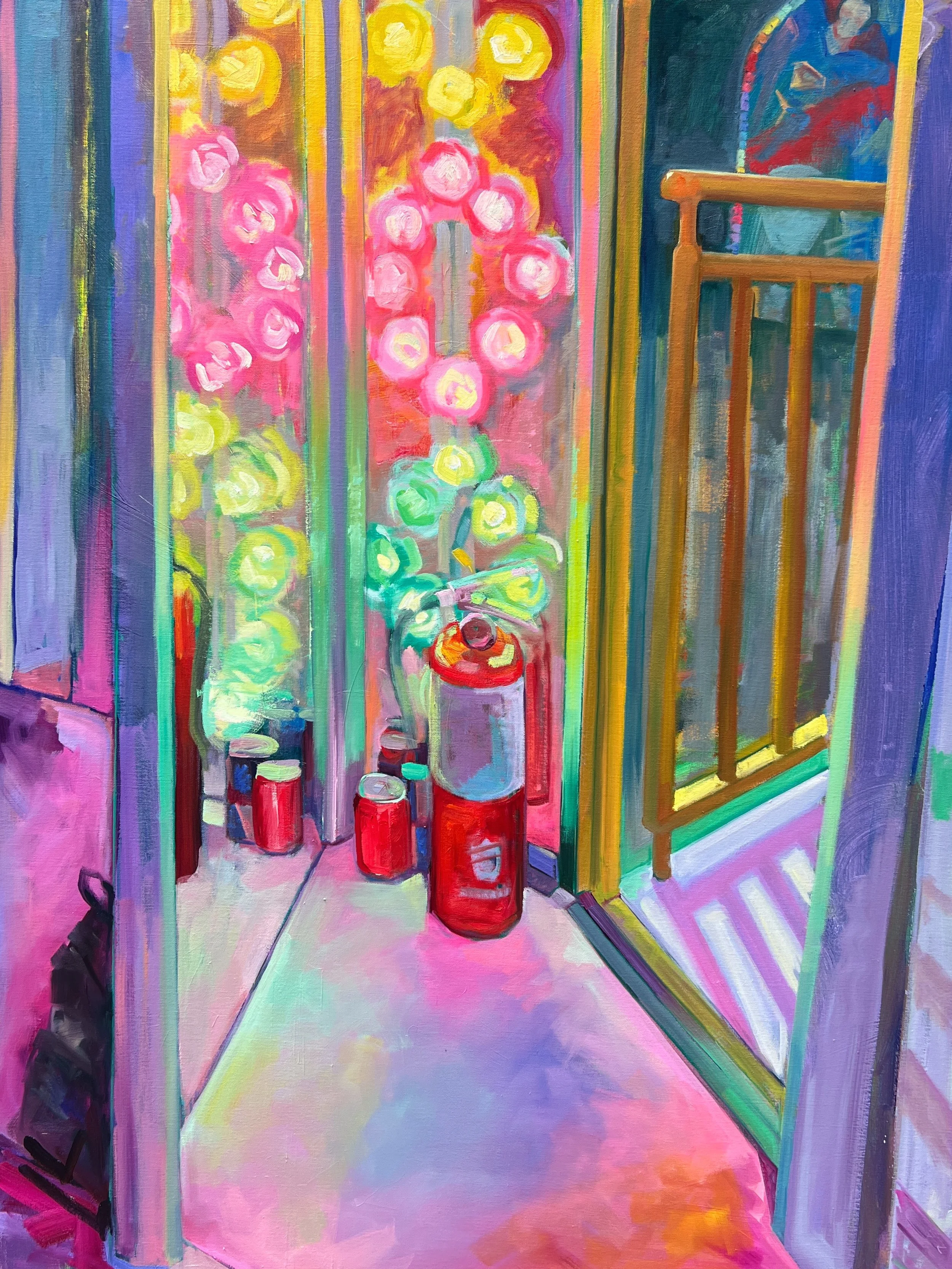
Superman Oil on canvas, 36×48”. 2026.
This painting developed out of my residency initiative to engage with the Fort Worth Stock Show and Rodeo, a three-week cultural touchstone for this city and wider area. The event also features a nightly carnival. When I attended the fair with my children on a particularly cold Texas night, I noticed, as I usually do, the people working it.
It doesn’t take someone who has lived in the underclass to find the mythology of the traveling carnival worker intriguing; the local fair is often portrayed in popular culture as a place where the surreal and strange emerge, and the trope of shadowy, eccentric “carnies” has grown from this motif. But a simple story-telling device betrays the uniqueness and humanity of a person, and the actual conditions through which the lives of real people unfold. As someone who grew up below the poverty line, I feel particularly inclined to see past stereotypes of the underclass.
Poverty is never far from my mind. There exists a common misconception that you leave all the trappings of being poor in America once your economic situation improves, but the scars of growing up with food scarcity, overdraft fees, and substance abuse do not heal so conveniently. I am forever grateful to have a career that allows me to live with a degree of comfort I never experienced as a child, but even as I sit here I am navigating a family member’s mental health decay as a lifetime of severe vulnerability takes its toll on them.
In my professional career I make paintings, but in many ways my life’s work has been seeking out the humanity in, and finding a proper way to talk about, underclass existence.
So when I happened upon this scene on a late January night, I saw a snapshot of a worker’s humanity, and a symbol of the often invisible labor of low-wage workers: a can of Red Bull and a Coke tucked behind a fire hydrant.
In the painting, two cans — someone’s night shift mapped out in caffeinated preparation — are tucked in the corner of a fun house mirror. The mirror reflects several iterations of the same two cans, multiplying them into something infinite. That struck me as the right formal language for what it often means to work those shifts: tired, and seemingly never-ending in a way that’s hard to wrap your mind around.
My process is usually to snap photos, make studies, veer off into stylistic choices, and then sit with them. Sometimes they graduate to formal paintings. This piece’s first draft sat in my studio for several months, through many studio visits, rarely receiving much notice from the people passing through. And yet it has remained my favorite of this body of work.
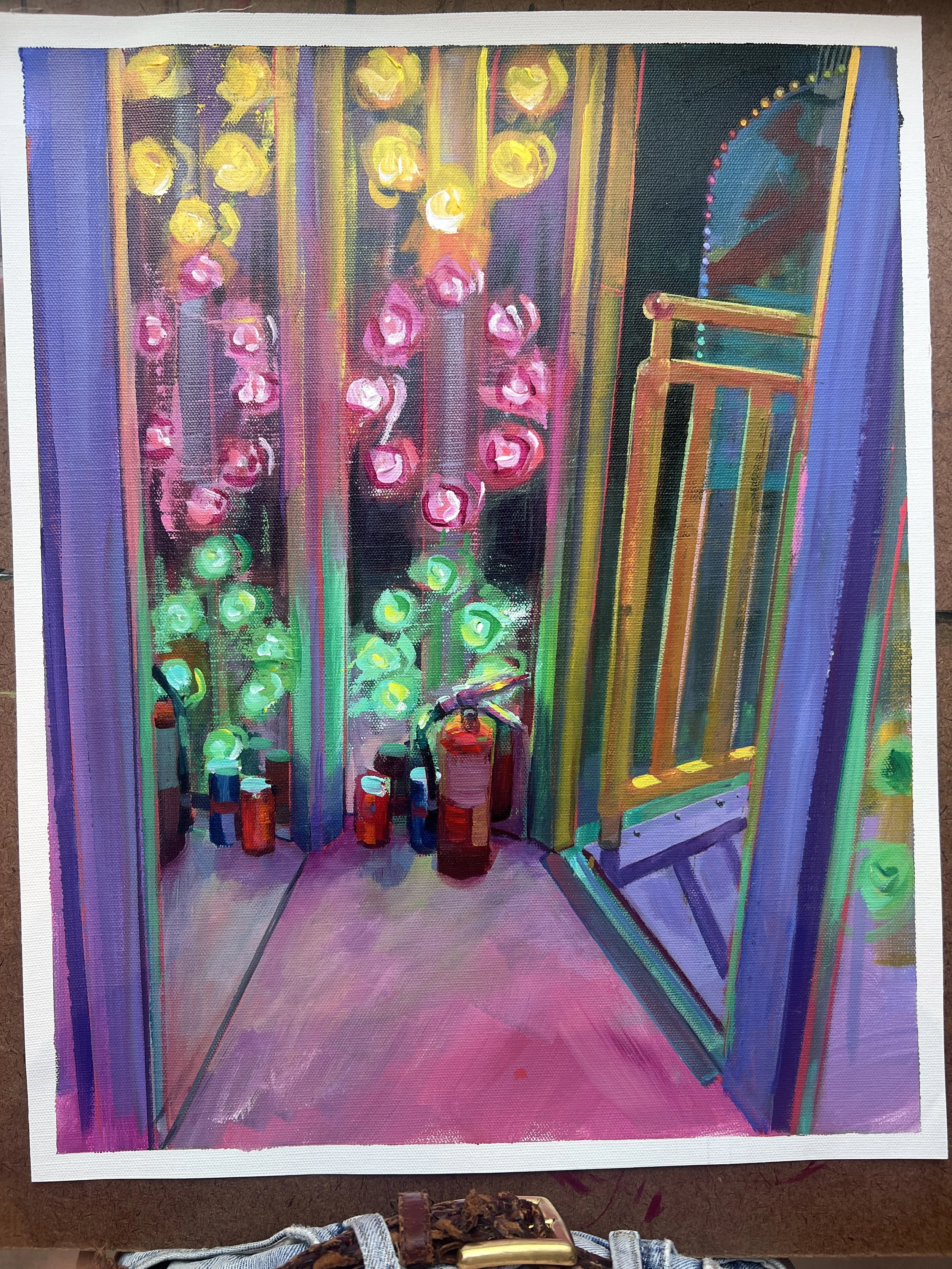
Study for Superman. Acrylic on canvas pad. 12×16”. 2026.
In fact, in the process of painting the study, working next to it for several months, and then finally completing the final piece this week, I have come to understand something fundamental about being an artist: what you’re drawn to, what you obsess over, is in fact the bedrock of your taste. Even a somewhat quiet, hard-to-read composition that never seems to jump out — if the meaning pulls you in, that’s the work.
In scaling it up, I leaned into my obsession with Richard Diebenkorn, specifically his Ocean Park series; his scattering and manipulation of surface, the tension he holds between representation and abstraction. I know that exploring this delineation is well-tread terrain at this point, having been interrogated through the mid to late 20th century by Diebenkorn, Willem de Kooning, and Gerhard Richter, to name a few. But for me, it has become a shorthand for playing with reality — and understanding shared reality is, arguably, the central conversation of our moment.
I have always taken issue with how lower classes tend to be depicted in media, as dirty and still often represented in black and white as if poverty were a relic of the Great Depression. The over-saturation, the color, the specific reality that the task is often simply to be present and part of the background for hours — that, to me, scratches closer to the unique texture of underclass life.
My residency solo show (opening in January) isn’t entirely about the underclass. But it’s in the DNA of everything. And it is never, ever far from my thoughts.