
Residency Report No. 6: The Stickiness of American Spectacle
A little over a year ago, I hosted a creative retreat in upstate New York and tacked on a visit to New York City afterwards. I made a point to stack every day full of art museum trips, in between the necessary NYC tourist stops. (I had my whole family with me and it was everyone’s first trip to New York City, so the Statue of Liberty, 9/11 Memorial and Central Park were musts.)
By far the most extraordinary experience of that trip, personally, came at The Metropolitan Museum of Art on a Wednesday, the day the Met is closed to the public. My friend Mac, an arts professional in New York City (someone I’ve bonded with over art and the shared experiences of living in Texas and growing up below the poverty line) gave us a private tour. I haven’t gone a day without thinking of this visit since.
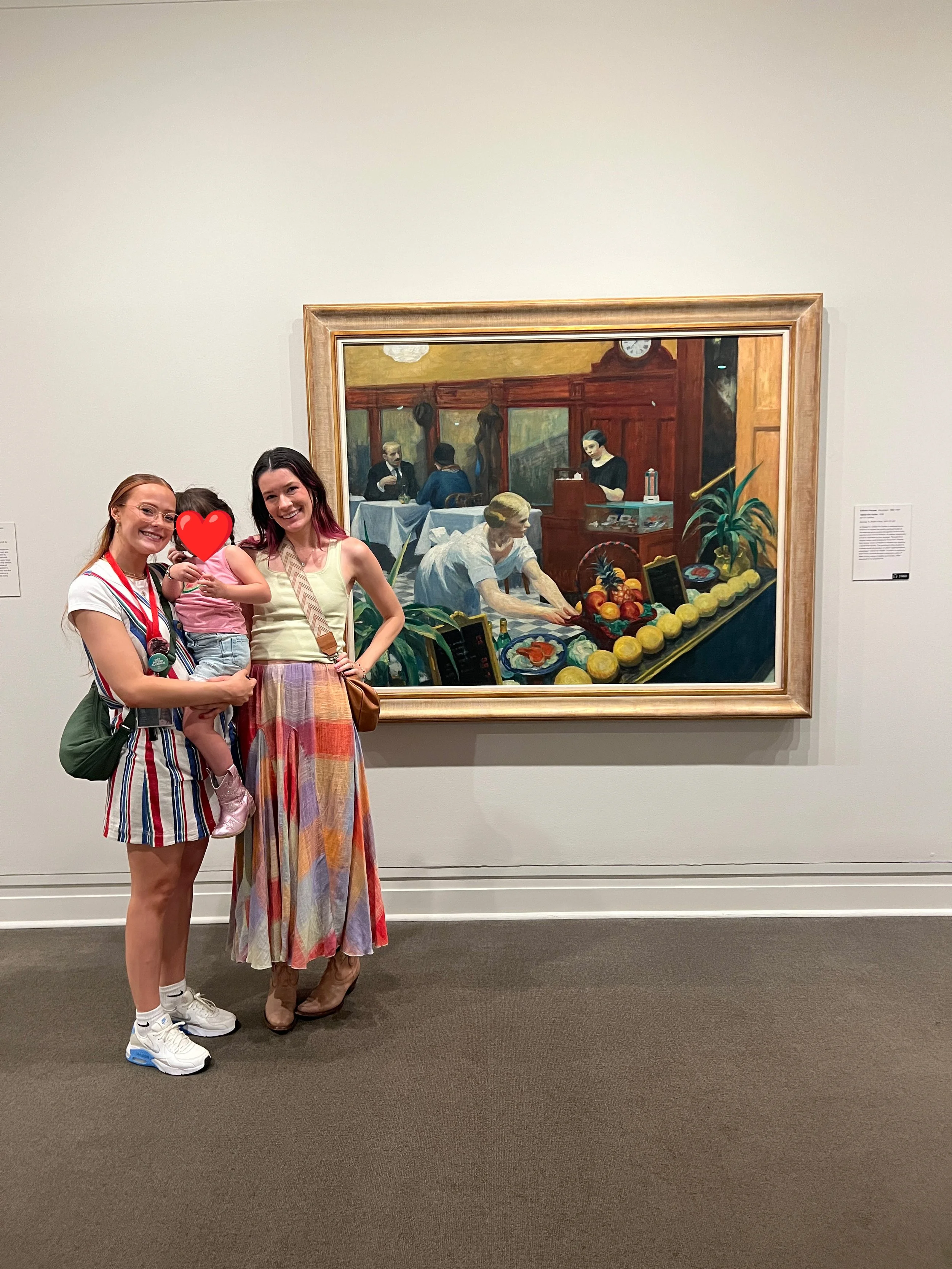
Mac, my daughter, and me at The Metropolitan Museum of Art (next to Edward Hopper’s Table for Ladies (1930)
As tempting as it was to linger forever in the empty galleries in front of the Sargent and Paris exhibition, lose myself entirely in the European paintings from Velàzquez, Vermeer, Van Gogh, Turner, and Cézanne, and in general wander forever through the cavernous halls, the moment that ultimately left the deepest impression was a surprising encounter in the tucked away nook of gallery 965.
One thing I love about visiting an art museum is the opportunity to be completely floored by a piece of art, and I find it particularly impactful when a piece does so unexpectedly. (The Sargent exhibit was thrilling, but I knew it would be.) On this day, I had such an encounter with Florine Stettheimer’s Cathedral paintings. On first glance, as is often true for me, I was drawn in by the pink. It’s difficult to articulate in writing what it means to do pink well, but I know it when I see it. Her piece The Cathedrals of Broadway specifically hit me with what I can only describe as a who’s who sensibility; the kind my reality-TV-loving teenage self would have instantly recognized and glommed onto.
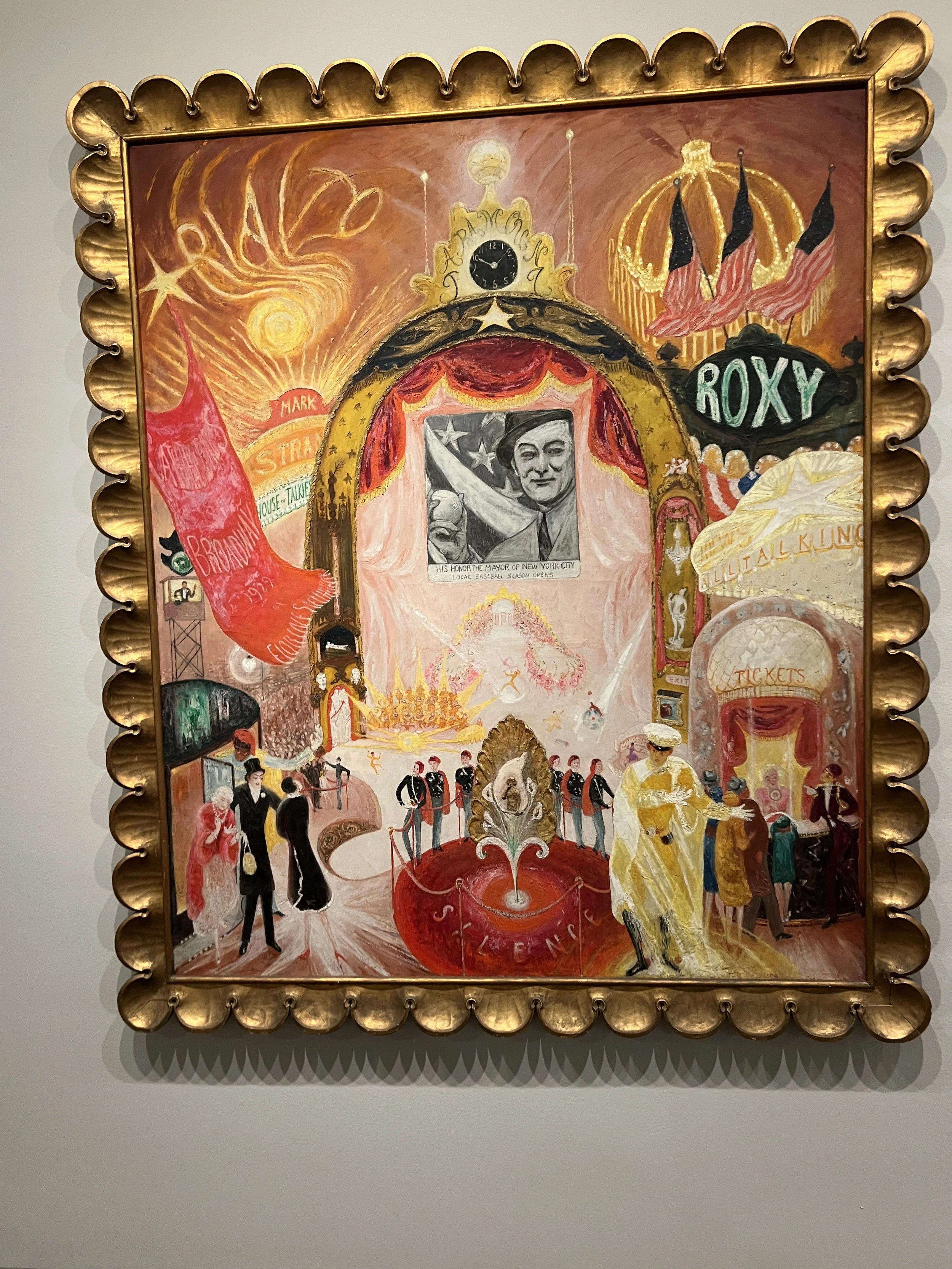
Florine Stettheimer The Cathedrals of Broadway (1929)
There’s a concept I’ve heard discussed in writing circles called stickiness, which is the idea that a piece or passage doesn’t necessarily announce itself as profound in the moment, but days later, you find it has snuck up on you uninvited. Spending a full day at the Met, other works may have jumped out at me more immediately. But the award for stickiest piece of that trip goes, without question, to Stettheimer.
Later that summer, conversations began about this residency that I’m currently in the midst of. As anyone who has read my previous residency reports knows, this project in Fort Worth launched in January with a charge to make a body of work referencing the rodeo. And as I’ve worked through these pieces over the past year, I’ve found myself returning again and again to Stettheimer’s Cathedrals and her ode to spectacle.
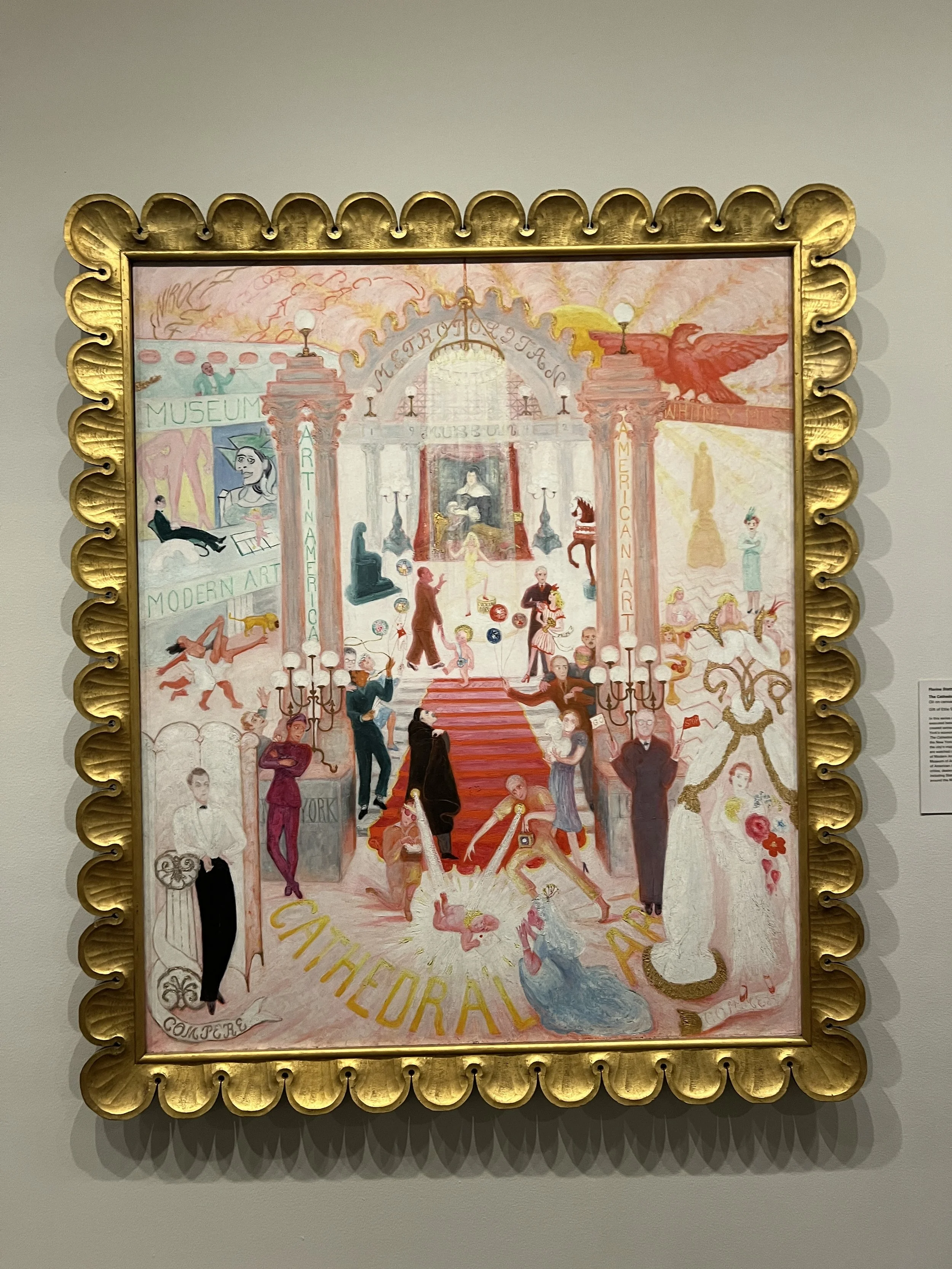
Florine Stettheimer The Cathedrals of Art (1942)
Upon more research, I learned something that deepened the connection. Stettheimer’s critical reception shifted from initial dismissive assessments during her lifetime to a more appreciative recognition of her originality following her posthumous retrospective in 1946. In 1931, the painter and critic Marsden Hartley served her what I interpreted as a backhanded compliment while arguing that her work belonged in “the rapidly increasing array of feminine expression in art” for its “ultra-lyrical expression of an ultra-feminine spirit, and must be considered as such if one is to enjoy the degree it is meant to convey.” (“The Paintings of Florine Stettheimer” by Marsden Hartley in Creative Art (July 1931))
She had, as I came to understand, the financial independence to do so as she never needed to sell her work to make a living, and so she was never beholden to market approval or critical consensus. She made work that collapsed the distance between fashion and fine art, performance and canvas. This is an instinct I share, and one that frequently comes to a head in my own practice.
What I find at the rodeo is something structurally similar to what Stettheimer found at Broadway, at Wall Street, at Fifth Avenue: a site where American mythology and money and identity perform for each other, and where the decorative surface is not incidental to the argument, but is the argument. She chose the cathedrals of urban modernity. I am exploring the Western arena. Both are places where we go to watch ourselves be who we think we are.
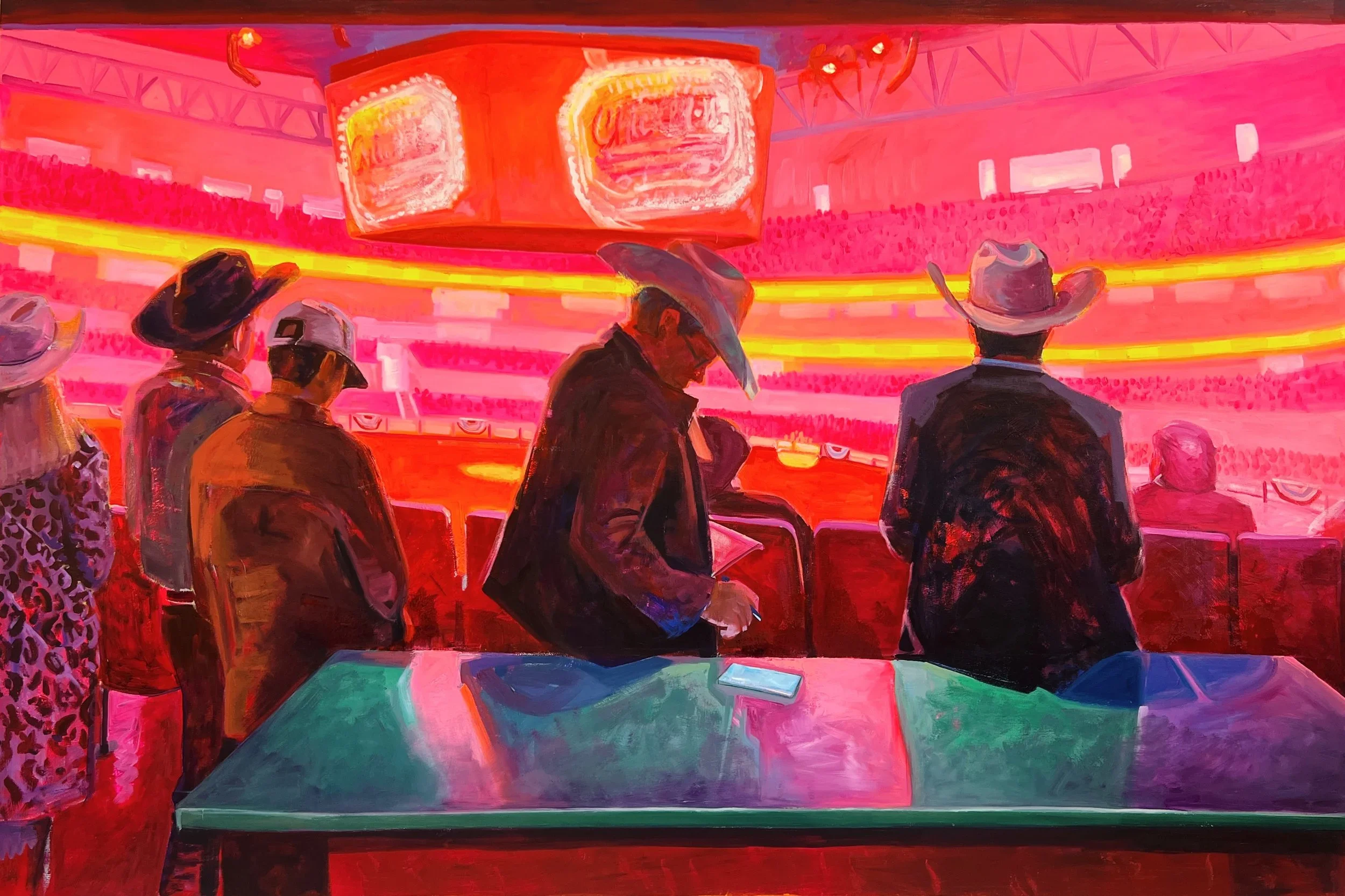
untitled (arena glow) Oil on canvas. 56x84” 2026.
There is, of course, a significant difference. Stettheimer’s privilege afforded her a particular kind of freedom. The freedom to be subversive without financial consequence.
What I keep returning to, across six months of research and writing in these residency reports, is that America at a crisis point of identity feels less like a historical marker and more like a permanent one. A nation founded on the principles of creed, when the defiance of creed is flaunted by institutions of power, may be structurally unable to stop asking who it is. The rodeo, like Broadway, like the frontier, like every mythology we have handed down and dressed up and put on the Jumbotron, is one of our ongoing answers to that question. It’s partial, performed, and stubbornly persistent. America is nothing if not a place beholden to spectacle.
I suspect this question of who we are is never far from any artist who chooses to grapple seriously with American identity. And if I have to name the works that have sat most reliably at the top of my altar of reference on this topic, it is Stettheimer’s Cathedrals and their ability to remind me that the decorative and the critical are not at odds, but in fact an unvarnished view at what we hold most dear.