On View: “Future Tense” At Hangar Art Studios
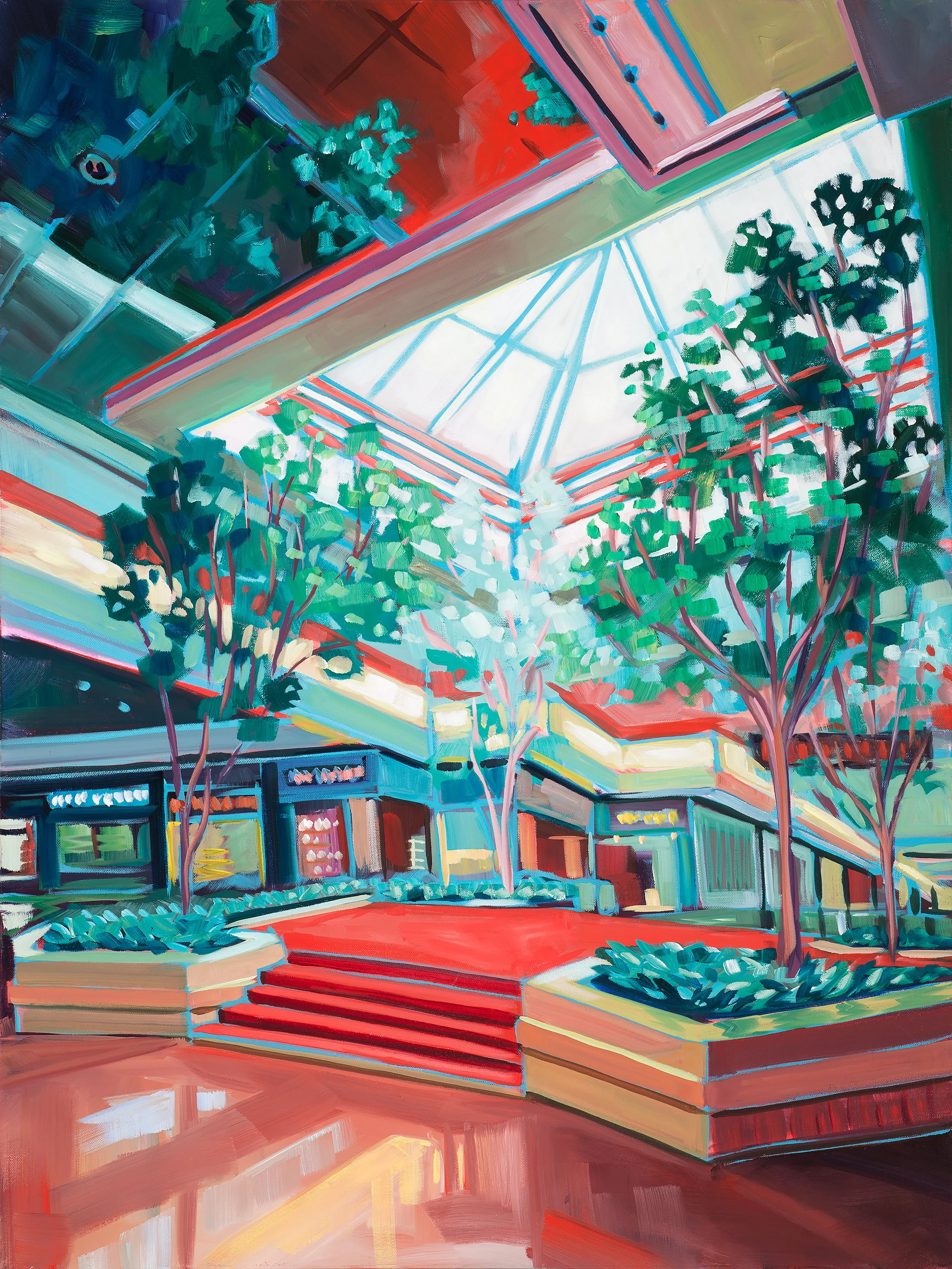
Red Staircase, Acrylic on canvas, 30×40” (2019)
My solo show, Future Tense, at Hangar Art Studios in south Austin opens August 28 from 7-9pm. This exhibit is comprised of 15 original paintings from my Mall Series, created over the course of three years (2018-2021). My thoughts and inspiration for this body of work are below. I hope you are able to check out the show, which will be up until the end of October 2025!———Why I Paint Malls
In the early stages of my art career (around 2018 through 2021), I started making mall paintings. These hyper-colorful, palatable, starkly empty works were a continuation of my attempts to grapple with nostalgia.
For me, nostalgia had already become a generational cliché. Millennials were (and still are) stereotyped as unwilling to grow up and chasing a version of childhood that maybe never existed. (This has been called Peter Pan syndrome— Disney adults anyone?) But for me this reckoning began as early as 2016, and it was complicated. On one hand, I had only just emerged from a childhood I would never willingly revisit. I grew up below the poverty line in the Missouri Ozarks, in a home that had all the familiar trappings of persistent poverty: parents who got pregnant in high school, dropped out, and struggled with mental illness, disability, opioid addiction, alcoholism, and domestic violence. Nothing in that past held comfort for me.
And yet, in my early twenties, I found myself pulled into the wave of nostalgia content circulating online—think BuzzFeed in the 2010s, “You know you’re a 90s kid if...” posts, that kind of thing. I started yearning for consumer goods I had never actually had access to: Tamagotchis, Ring Pops, Hollister hoodies. It made me realize how deceptive nostalgia really is. Intellectually, I wanted nothing to do with my past, but viscerally, I craved the comfort of being marketed to as a child.
At the same time, nostalgia was being weaponized politically. “Make America Great Again” is, at its core, an invitation to return to a false “good old days.” But going backwards is a lie if progress is the goal. Even as recently as 2015, basic rights like marriage equality were still being fought for. (Not to mention the rights that are actively being stripped away as a result of this current administration.) That awareness—that nostalgia can be both seductive and dangerous—pushed me toward images that nodded to the recent past.
Malls in particular fascinated me. They already had a cult following in the late 2000s and early 2010s: vaporwave forums, “dead mall” blogs, YouTube channels like Dan Bell’s documenting abandoned spaces. Personally, my interest tied back to my identity as a landscape painter. I’ve always loved the idea of painting as a portal, a window into another space. Empty malls offered exactly that—spaces at once familiar and strange, decadent and hollow.
My parents were born in 1967 and 1969, meaning they were teenagers and young adults in the 1980s. Between that being their most defining decade, and the fact that most of our clothes and home goods came secondhand, the fingerprints of the 80s were all over my childhood, even though I actually grew up in the post-9/11 shadow of the early 2000s. In my early twenties, I thought that if I could “solve” the 1980s (understand the politics, culture, and aesthetics) I could also better understand my parents and why my childhood felt the way it did.
And in a way, I wasn’t wrong. The Reagan-era shift away from social programs and toward rugged individualism, deregulation, and cheap consumerism created the conditions for the flavor of poverty my family lived through. The 80s also embodied a paradox: on one hand, they were about embracing the future— new wave, MTV, neon confidence; on the other, they masked deep anxiety, especially in the shadow of the Cold War. Writers like Bret Easton Ellis captured this in American Psycho, showing that beneath the slick glass-tiled surfaces of malls and offices was a hollow, anxious, and violent core.
If I can summarize the 80s glibly, it felt like a pep talk—an American pep talk. You’re great. You can consume. You can be shiny. Freedom is buying cheap things. You are what you consume. Bigger is better. Cue Peter Gabriel’s Big Time. If you can dream it, you can live it. And as Fred Armisen aptly put it in his comedy special Standup for Drummers, the 1980s was the decade when we all collectively decided, “the future starts now.” From the spaceship-like, new wave aesthetic to MTV transforming music into a visual medium, the 80s leaned into that confidence.
And while the shopping malls I painted weren’t all built in the 80s, they all carry that feeling. To me, malls were America riding its own pep talk for as long as it could—until it inevitably fizzled out. Of course, malls still exist. In Texas, outdoor Galleria-style malls thrive, even as so much of our shopping shifts online. Personally, I’ve found my own solace in secondhand stores. But when I painted these works, malls were my obsession.
This series is, on one hand, a meditation on trying to understand my parents. On the other, it feels like listening in on the internal dialogue of a culture—our consumeristic psyche played out in architecture. My palette for the Mall Series was intentionally optimistic, echoing that pep-talk aesthetic, yet the emptiness is haunted. A mall without people feels emptier than a field without people. That eerie contrast owes something to Edward Hopper, who used light, whether natural or artificial, to illuminate loneliness.
But it’s not only critique. As disability activist Imani Barbarin (@crutches_and_spice) has pointed out, malls have also been inclusive spaces— accessible, climate-controlled, with elevators and escalators. They’ve been gathering places for mall walkers, for moms with kids, for people seeking air-conditioned community. To dismiss them as mere monuments to overconsumption is to miss their complexity.
That’s what continues to draw me in: their scale, their contradictions, their ability to be both personal and collective at once. What began as an intimate attempt to understand my own childhood and family is also an invitation. These paintings are not just my nostalgia or my critique. They’re portals. They ask you to project your own memories, your own ambivalence, your own feelings onto a space we’ve all passed through.
———
Hangar Art Studios is located at 3625 Menchaca Road Suite 101, Austin, TX 78704. The gallery is open Friday through Sunday 12-5pm and by appointment.