I’ve always loved February and early March in Texas, when the weather begins to mellow out. The first good spring rains arrive, and things begin to bloom. One of my early Pinterest-darling still lifes was called Valentine’s Breakfast Still Life, made as an ode to that moment when the first flowers start appearing around Valentine’s Day. Even though winters here are generally mild, spring can never come soon enough for me.
When I think about this past month in the studio, a few major moments come to mind.
A Month of Master Studies
If the lead-up to the residency was about studying the history of Fort Worth and reading, and January was about making studies from the photo references I took at the rodeo, then February became the month where I reached into the depth of Western art history for guidance.
Sometimes people talk about “speaking to their ancestors,” and I’ve never quite resonated with that phrasing. The closest I come is by trying to have conversations with painters who came before me—studying how they solved problems, how they thought about the world, and how they responded to what they saw.
In January I did a sketchbook study of a Maynard Dixon piece. At the start of February I made a couple of studies after George Bellows, whose work often moved through the world of sports and entertainment as a way to understand society. I also tried my hand at The Runners (1926) by Robert Delaunay to study at conveying motion in simple forms. This was specifically helpful in my continued rodeo-focused work.
After an artist visit where Thomas Hart Benton was brought up, I revisited the Regionalists, which, along with the Ashcan painters, were a group I studied intensely in college.
At the start of this month, I turned to Hilma af Klint, specifically her painting Two Swans. One of my recent pieces from this month felt more graphic than anything I had made before, which led me to examine how she uses silhouette to imply line without explicitly drawing it. It’s a way of creating the illusion of line through form alone, something I’ve been experimenting with recently.
As I write this, I’m translating that idea into a Western motif: a rider and horse paired with its opposite form, almost like a yin and yang. I’m inspired by af Klint’s engagement with theosophy and the way symbolic shorthand can convey expansive philosophical ideas.
I also revisited the work of John Alexander, whose book was gifted to me this past summer by a friend who once assisted him in the studio. Alexander is a Texas-born painter who spent much of his early career in Beaumont before eventually moving to New York. There’s something about the way Texas landscapes, botanicals, and florals remain embedded in his work that resonates with me. I examined his paintings of melons while thinking through aspects of the floral paintings I was making this month, which led me straight into another master study.
Finally, I completed a small study of Albuquerque No. 4 (1951) by Richard Diebenkorn. I hesitate to call it a full master study since the scale is so much smaller than the original, but I did my best to stay faithful to the structure of the painting.
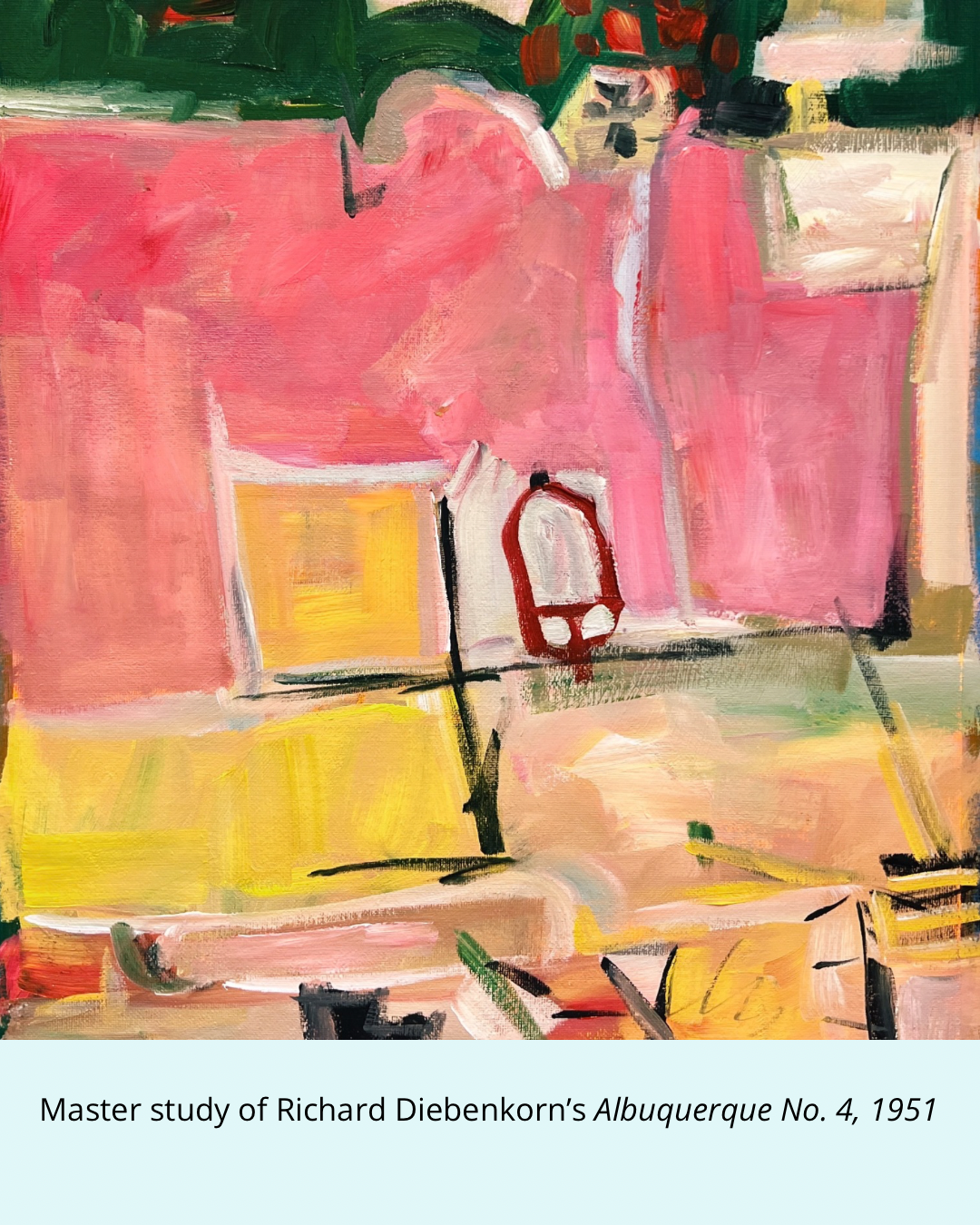
For nearly two years now, I’ve had a deep fascination with Diebenkorn’s work. Seeing one of his paintings in person at the Modern Art Museum of Fort Worth revealed something I immediately recognized as the game I want to play in my own work: the tension between representation and abstraction. I have always been a representational painter, but representation for representation’s sake has never been the end goal. It’s a means of communication.
I often use the analogy of photographing the moon to illustrate my point. You look up at the sky and see a beautiful moon. You take a photo, and even if the image is technically accurate, it never quite captures the experience. Sometimes an abstracted moon painting feels more truthful than the photograph.
That pursuit of a kind of transcendent truth beyond strict representation is something I continually chase.
Rashid Johnson at the Modern
A really special event from the last few weeks was attending an artist lecture by Rashid Johnson at the Modern Art Museum of Fort Worth. His exhibition, A Poem for Deep Thinkers, is currently on view there, and I highly recommend seeing it if you’re anywhere near the DFW area. I saw a different version of the exhibition this past summer at the Guggenheim Museum in New York, and despite similar works, the installations feel dramatically different due to the spaces themselves.
Johnson spoke about many aspects of his practice, but several ideas stuck with me.
At one point he discussed a self-portrait in which he styled his hair after Frederick Douglass. His mother, a historian of African history, played an indirect role in this reference. Johnson noted that early in an artist’s career we often lack enough personal reference points to build from, so we look backward to history to contextualize ourselves. This really resonated with me, especially after spending a month immersed in master studies.
He also discussed the spiritual dimension of his work. Johnson uses titles referencing spirits, souls, and God, not necessarily as literal statements but as conceptual resting places— points where viewers can project their own emotional and philosophical ideas onto the work. As someone interested in linguistic relativism—the idea that language shapes perception—I found this fascinating. In some cases, his titles function almost like poetry accompanying the work.
But the point that struck me most was his comment that artists of his generation grew up in what he called a “post-medium” world.
My own painting professor in college, who received his MFA from the School of Visual Arts in the early 1990s, often talked about the prevalence of video art and conceptual practices at the time. By the end of the 20th century, artists had spent decades breaking away from traditional mediums—ever since Marcel Duchamp put to bed the idea that art needed to be defined by technical mastery. Eventually, it began to feel as if all the obvious flags had already been planted.
This, of course, leads to the conversation I still occasionally encounter: Is painting dead? My answer has always been no.
Even in college, when I had fewer tools to articulate it, painting felt like a stage to me. A stage is just a stage—what matters is what happens on it. A painting is simply a bounded surface where something can be projected, expressed, and explored.
Coming from a lower class background, and as a woman, I rarely saw my experiences reflected in the historical narratives of painting. To me, painting could not be dead as long as there were voices and perspectives that had yet to meaningfully inhabit it. There was also something deeply personal about skill.
Watching my parents work physically demanding jobs where their labor and expertise were undervalued left an impression on me. Developing a skill—something I could cultivate, refine, and ultimately own—felt like a kind of reclamation. Showing up to a canvas, drawing, blocking in, refining, and producing something that demonstrated skill felt meaningful in the same way that earning a college degree did.
But beyond all that, I simply enjoy painting. I enjoy color. I enjoy surface. And I enjoy the strange magic of creating the illusion of reality on a thin plane of pigment.
In David Batchelor’s book Chromophobia, he discusses the historical suspicion of color, which is often derisively associated with femininity, cosmetics, or superficiality. Color is sometimes dismissed as something applied to the exterior, something artificial. Yet there’s a kind of honesty in that artificiality that I find compelling. Paint is, after all, a deliberate illusion.
Making art is, in many ways, my second language, and I often find it as a better means of expression and communication than words.
A Brief Studio Visit
One unexpected highlight of the residency has been the opportunity to receive studio visits from artists and curators I greatly admire. While I’m not usually someone who gets starstruck, there have been a few moments where I’ve thought: I can’t believe this person is in my studio.
I was fortunate enough to spend a few brief minutes with Rashid Johnson here. We talked specifically about Wayne Thiebaud and Richard Diebenkorn while looking over my Diebenkorn study.
Johnson remarked that Diebenkorn might be one of the most impactful artists of the twentieth century—not just painters. Hearing that from someone whose work I admire, and whose practice exists squarely in the post-medium world, felt incredibly validating.
Diebenkorn’s work occupies a remarkable space: it dismantles representation while remaining tethered to it. His paintings create the illusion of light and place while simultaneously emphasizing the surface—each mark, each plane, each intersection of color. Through his own obsession with artist predecessors like Hopper, Matisse, and Mondrian, Diebenkorn studied art history voraciously, and he tread their paths before carving his own in a space somewhere between abstraction and representation. His Ocean Park series makes me feel form, color, and texture in such a refreshingly unique way.
His works feel spontaneous and joyful, almost like watching someone record a dance on a two-dimensional surface. Yet they are also intensely thoughtful. What I initially assumed would be a brief fascination with his work has now stretched into several years of obsession.
Where That Leaves Me
A few of the larger paintings I finished at the end of February and the beginning of March were the most I’ve ever allowed myself to throw perfect accuracy to the wind.
Not in the sense of abandoning precision entirely—that’s always the tightrope painterly painters walk—but in allowing intuition, color, and structure to lead the way.
One example was a still life inspired by Ursula K. Le Guin’s 1986 essay The Carrier Bag Theory of Fiction. In her piece, Le Guin argues that simple containers, like a carrier bag or satchel, deserve much more credit as foundational human tools, especially compared to the outsized reputation given to weapons. Since so much of our diet throughout history has been gathered as opposed to hunted, and since those foods and other items key for survival could be collected and stored, it bears reason that containers would play an equal, if not greater, part in human storytelling than the tales of killing and conquest. But of course, stories about bags aren’t nearly as adventurous and exciting as heroic hunters and warriors, and Le Guin argues this has diminished our understanding of how critical the tools that protect our longevity truly are.
So, after teaching an impromptu Friday afternoon lesson with the Sundance Square art department, I photographed the table we had set up for color inspiration. The gathering itself—people sharing ideas, enjoying each other’s company—became the subject.
Once again, when I struggled to resolve the painting, the answer was simple: look to Diebenkorn.
Wisdom
I sometimes suspect that my early thirties place me at the lowest point of the Dunning–Kruger Effect.
The bold certainty of youth has worn off, and what replaces it is the vulnerable awareness that you know very little. It’s a kind of ego death—humbling, sometimes frightening, but also freeing. Confidence exists, but it is quieter.
Looking to painters—both living and dead—became something of a life raft for me this month. Immersing myself in mark-making, color, and the technical language of painting helped ground me.
If there’s anything I might offer to other artists reading this, it’s this: Don’t be afraid to look to your artistic ancestors for guidance. Ask painters you admire. Ask the ones who came before you. Ask the ones working around you now.
They won’t tell you exactly what to paint. That’s not how it works outside the walls of an art school studio. But sometimes you’ll encounter a flash of insight, a moment where your thinking aligns with someone else’s across time.
And those brief moments of recognition—those flashes of kismet, simpatico, awareness, truth—is something I grow more grateful for every year.