
Where The West Began: Who Gets To Claim The Cowboy?
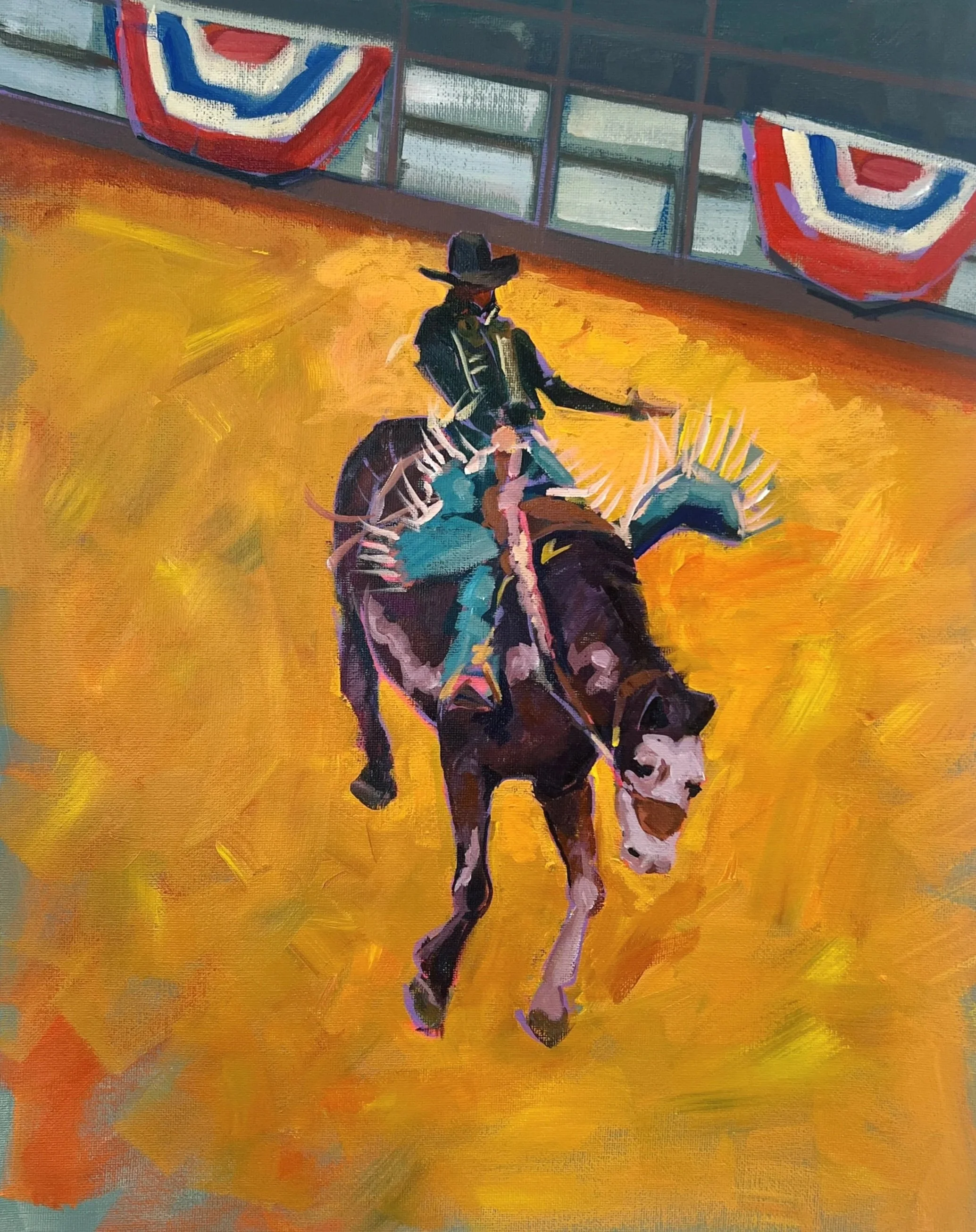
A study from the 2026 Fort Worth Stock Show & Rodeo. Acrylic on canvas pad.
Recently, I had the privilege of attending the Black History Month program at my son’s school. The entire pre-K-5 participated, with each grade level performing songs and dances highlighting the immense impact of the Black experience on American history. There was food, gift bags, printed programs and small Black History Month flags the children waived throughout the evening.
As a parent, I’m always impressed by the coordination of a cohesive program featuring an entire school of elementary students— surely no small feat. Joy is contagious in the presence of children working together in a creative pursuit, and through their collective efforts I was delighted by the breadth of contribution being honored: music, art, science, technology.
In addition to songs by the Temptations, Prince, Michael Jackson and Outkast, to name a few, there were student performances to honor inventor Lewis Latimer’s telephone patent (performed via a game of telephone) and double dutch jump rope as an ode to the sport invented by former NYPD officers Ulysses Williams and David Walker. The cafeteria was repurposed for the night as an art gallery, with the work of Kerry James Marshall and Henry Ossawa Tanner among those on digital display.
When the celebration got started, the faculty and student body read aloud a Black History Affirmation:
I am here to live!
I am worthy of success.
I am worthy of love.
I am not who or what they say I am.
I deserve peace and happiness.
I am here for a reason.
I am needed.
I am heard.
I am loved.
Hearing this beautiful affirmation and reading it over and over again on the program, I couldn’t help but to contextualize its message within the far right nationalist efforts to disparage and discredit our nation’s diversity and the minority populations living here.
As a millennial who can clearly recall the 2014 Ferguson protests and the nationwide response to George Floyd’s murder in 2020, I have come of age as this country has undergone a cultural reckoning with racial injustice. Those tragedies were amplified by the fact that they were not outlier experiences for the Black community, but a reality of fear in everyday life. The Black Lives Matter movement has been instrumental in maintaining the momentum of the 1960s Civil Rights movement in the modern age, and I am grateful for their work as we in the United States are too frequently reminded that any threat to progress is a slippery slope to cultural regression.
The oppression that Black Americans experience makes their gigantic cultural imprint all the more impressive and inspiring to me. So when I heard the words of this affirmation read by the children, and watched them dance to music by some of the best artists in history, I was overjoyed to celebrate the magnitude of Black American contribution to this country. Black history is central to American life, and although I am not Black, I am always honored to celebrate their culture with them.
I recently heard historian Heather Cox Richardson say in a podcast that the Black American experience is not an addendum to the American story but arguably its essential point of view — the most honest lens through which to understand who we are. That framing resonates greatly with me. It’s a reminder that any argument that America needs to return to a supposed better version of itself from the past is historically revisionist at best, and deliberate omission at worst.
Waking up the next morning after the program, I rose early, dropped my kids off at school, and shortly after, I walked to my art studio. When I got there, I did what I usually do before switching on a playlist and prepping to paint: I scanned the news. I’m always drawn to moments when America broadcasts to the world who it is, when the country presents an idealized version of itself — World’s Fairs, Olympic ceremonies, global summits, diplomatic speeches. On February 14, Secretary of State Marco Rubio addressed the Munich Security Conference.
In his speech, Rubio linked the United States to Europe as parts of the same Western civilizational whole, united “by centuries of shared history, Christian faith, culture, heritage, language, ancestry and the sacrifices our forefathers made together for the common civilization to which we have fallen heir.” Within his historically inaccurate and racially charged delivery, Rubio made a seemingly innocuous claim which caught my attention: cowboy culture was born in Spain.
The motivation of this speech was clear: to Rubio, an idealized America is an extension of Europe — culturally, civilizationally, perhaps racially. And of course, his premise cannot be ignored. Europe, like the United States, is grappling with immigration driven by geopolitical instability and climate change. The appeal to shared Western heritage functions as a kind of consolidation — an attempt to define who belongs within the civilizational frame and who does not.
But as New York Times opinion columnist Jamelle Bouie points out, this framing is historically weak. The American Revolution was, in many ways, a rejection of what Europe represented: monarchy, inherited hierarchy, aristocratic power. As Bouie references in his column, founding father Thomas Paine wrote that the independence of the United States from England was much more than a splitting of factions, as it was “accompanied by a revolution in the principles and practice of governments.” It was through that revolution that the United States became its own independent land of thoughts, ideals, and people, not merely a spawn of Europe as Rubio suggests.
Which brings me back to the fourth-grade gymnasium and the children declaring they are worthy. To a school that understands that America’s most honest self emerges from those who were historically denied entry into its promises. America is defined by a creed of “liberty and justice for all”, not some inheritance imported from Europe.
Rubio’s speech was nauseating — as, unfortunately, most releases from the White House during this administration have been. His rhetoric framing immigration as a destabilizing force in Western society is borne of hatred and ignorance. As much as I try to keep the news on a need-to-know basis, I’m currently in a one-year residency where part of my focus is to sit and think. I’m slightly off my entrepreneur grind — daily posting, constant output, new small works for social media — and that space has given me more bandwidth to consider how my practice and what I think plugs into the greater world.
Even writing that feels lofty. Bigger than what it feels like I’m doing on a day-to-day basis, which I suppose, in part, motivated me to write this article. This is what artists do— we metabolize culture and break it down.
When Rubio remarked that America is “a child of Europe” and attributed “the entire romance of the cowboy archetype that became synonymous with the American West” as coming from Spain, my ears immediately perked up. For the last few months, I’ve been diving into the history and context of Western culture in anticipation of and as part of this residency. I dedicated much of January and early February to attending the Fort Worth Stock Show & Rodeo and immersing myself in the spectacle and culture in Fort Worth, its slogan being “Where the West Begins.”
So I’ve been asking: where did this culture come from? If you stopped someone on the street in any American city and asked where country and Western culture came from, they’d likely say: America. It feels squarely American. Unlike holidays such as St. Patrick’s Day or Cinco de Mayo — which are widely understood as diasporic cultural imports reframed in the U.S. — country and Western culture is often perceived as native to this soil.
And yet, as the United States has long fashioned itself — at least in the mythology I grew up with — as a “melting pot,” many of the things we consider quintessentially American are adaptations, hybridizations, improvisations born of immigrant influence. Country and Western culture is both uniquely American in execution and multicultural in origin.
The cowboy emerged on the frontier of the West. (Conveniently left out of Rubio’s claim as Spain being the birthplace of the cowboy is that, according to an article by Katie Gutierrez for Texas Highways, the original cattle drivers—who the 16th century conquistadors derisively labeled “vaqueros” (translates to “cow men”)— were the Spaniards’ Moorish slaves, Black Muslim men who did the work that these Spanish men didn’t want to on the frontier in modern day Mexico.) There were influences from Mexico, French trappers, Spanish settlers who introduced horses, and Indigenous nations who reshaped equestrian culture after the arrival of those horses. Black and Hispanic cowboys played a tremendous role in shaping Western culture, as they represented nearly half of the cowboys during the post Civil War cattle drives in the 1860s to 1880s, according to Fort Worth Magazine.
There is also the land itself: the Great Plains. The largest flat expanse in North America, the 1.1 million square mile plot stretching from the Rocky Mountains to the Missouri River and from Canada to Texas, was used heavily for cattle driving before homesteaders settled in greater numbers in the late 19th and early 20th centuries. Culture is not just imported — it is shaped by terrain. Yes, horses were introduced by the Spanish, but the deeper question is: whose culture is required to produce receipts and timestamps, and whose culture simply gets to be assumed as heritage?
Look at food. When you think of Italy, you likely think of spaghetti, pizza, Bolognese — all tomato-based dishes. Tomatoes were introduced to Europe from the Americas after the Columbian Exchange. If we are going to use the Columbian era as a dividing line between “heritage” and “New World multiculturalism,” should we strip Italian identity of tomato-based cuisine? Similarly, when you think of Ireland, you likely think of potatoes — another New World crop.
My maiden name is Higgins. I joke that my love of potatoes is part of my Irish heritage. No one has ever interrupted to say, “Actually, that’s post-Columbian and therefore not authentically Irish.” Culture does not function that way. And yet there is a recurring insistence — especially in nationalist rhetoric — that culture is fixed, solid, unified, unchanging. That it must be stable in order to justify racial and civilizational boundaries. This is why Rubio’s speech felt like a tell as an attempt to reform and re-contextualize history in service of present political goals. This is not new.
Weaponizing history as a way to reinforce racial hierarchy is dangerous. What makes this personal for me is that I see a school gymnasium filled with predominantly Black and brown children being told they are worthy, special, essential to this country. And I see a political project that would prefer to redefine America along narrower civilizational lines. History reminds us where that broken logic leads — toward discrimination and violence at both macro and micro levels.
As progressive discourse constantly asks, “What can we do? How do we push back?” one small but significant act is to understand and articulate that something as quintessentially American as country and Western culture is deeply multicultural. It has major contributions from Indigenous Americans, Mexican Americans, and Black Americans — three groups with no ancestral ties to Europe who, through their own traditions and heritage, have helped mold the American cowboy into the cultural juggernaut it is today.
Western imagery has too often been used as a backdrop onto which we project simplified racial narratives, often positioning white frontier identity as adversarial to Black, Indigenous, and Hispanic cultural contributions. That framing is false. Western culture is not an enemy to multicultural America. It is evidence of it.
To keep the historical record straight — to insist on the multicultural origins of what we consider “American” is a line worth holding. I was reminded of this as I sat in a small gymnasium in Fort Worth, Texas, enthralled by a collection of elementary students celebrating the America that truly lives by the notion that all men are created equal, and there is liberty and justice for all.